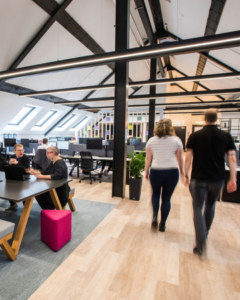

A good starting point for a new office project is a series of questions. “What is it that you do?” followed by “What’s the purpose of the office?” and finally, “What do you want to achieve with the new office?” will get you a long way.
A consultancy and data-led approach rather than design-led allows for a better solution. Granted that glossy photos of exposed ceilings, AV-enabled formal meeting rooms, and panoramic views from the well-appointed employee café have a part to play. But underlying these needs to be a robust brief of what the space (or spaces) needs to deliver.
Functionality before wow
A successful office project will look good on day one and support activity-based working, offering variety and choice. A really successful project will still support your employees five years later. It may have changed slightly (organisations, ways of working and spaces all evolve – in sync where possible) and it may show some signs of wear and tear. But if your people are able to still say “this works” long after the photos for the website have disappeared from social media, then it’s a success.
What do we mean by functionality?
We mean creating an environment made up of different spaces that caters to different work modes and different employee characteristics. That’s spaces that allow you to get on with focused work (solo and group) free from distractions, spaces that allow teams to come together (the office is still the best place to connect with your colleagues, clients and visitors), and often, spaces that support very specific processes. It’s the lighting, the temperature, the control of noise (or the creation of different atmospheres). It’s the fact that the employee kitchen has been designed with the flow of people in mind. That’s functionality.
It’s not just about the physical however, it’s the technology and the protocols – these also need to be suitable for all your employees. From those who are in five days a week to those who work remotely and only touch down for short periods now and then.
Functionality is underpinned by understanding your activities, your processes, the way you interact and ultimately, your people.
Where does the wow come in, and what do we mean?
You could think of functionality as the mannequin and the wow as the clothes.
Employee retention is heavily influenced by functionality. For employee attraction, it’s the wow factor that plays to our basic human nature. We can be pretty shallow at times; a nice boardroom and a good cup of coffee at your interview can go a long way to sealing the deal.
Wow is all about aesthetics and that opens up a whole can of worms when it comes to “what is good design?”
Good design, in some respects, should not be in your face. It sets the tone, projects the corporate image and showcases how the organisation wishes to be seen – both by the market and by their employees. Does it need to be stylish? One could say that yes, it should be stylish. Should it be fashionable? Designers are aware of trends but shouldn’t be dictated to by them.
Functionality and wow. Can they work together? Yes, they have to. Without each other you either have a sterile environment that does absolutely nothing for the employee experience (and remember the office is competing with the home – a place the employee has personalised), or, to put it bluntly, a hot mess that confuses and confounds the end user and drives people away from the office.
Functionality plus wow is the perfect combination. It takes skill, understanding, restraint (yes) and confidence to get it right. But when you do, you’re onto a winner.